


Cartier's Tutti Frutti is a necklace

I’ve sure we’ve all heard of Cartier, the long-time (since 1847) luxury jewelry house based in France. They’ve always had a reputation for gorgeous designs and high quality gemstones. But today, I want to tell you a story of the most famous necklace they ever designed. It’s made up of carved emeralds, rubies, and sapphires. And in its time, no one had seen anything like it. Isn’t it absolutely fabulous?
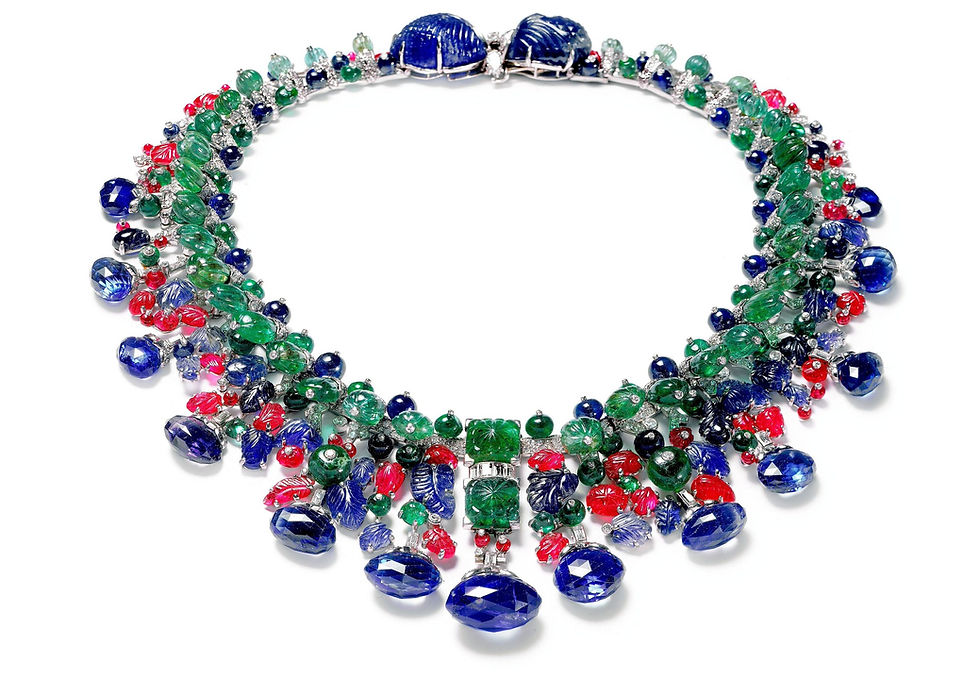
This necklace is called the Tutti Frutti necklace. Perhaps you’ve heard of Tutti Frutti? It’s a song (by Little Richard, Elvis Presley, and even Queen), a dessert and even a yogurt company. But obviously, my fellow jewelry lovers, the most important Tutti Frutti is this stunning piece from Cartier.
The influence of India
The necklace design was heavily influenced by India. In the 1800’s, England and India were “trading partners” and it was the height of the Mughal Empire. The maharajahs (the rulers) were incredibly wealthy, and they loved to show it off with jewelry. They wore massive, elaborate, multi-strand necklaces and bejeweled turbans. Knives and swords were dripping with gemstones too.

This was the environment Cartier found himself in when he visited India in 1911 to celebrate King George V’s coronation. In addition to being King of England, George was also being named Emperor of India. I mean, how boring to just rule one nation…… Anyway, while Cartier was there, he was inspired by all the gorgeous things he saw - carved gemstones, massive emeralds and rubies, silk cord, stars, pearls and diamonds. He brought these gemstones back to France to use in his own designs. He wasn’t sure what those would be yet, but he was interested in experimenting.
Colors and Carvings
The jewelry in the early 1900’s was delicate and white with diamonds and platinum. It was a huge contrast to what Cartier saw in India. The massive use of color was overwhelming. It wasn’t just the color that was so different. It was the unique way they carved their gemstones. By the 1900’s, the Mughals has been carving gemstones for three hundred years. They engraved words and phrases. They dearly loved emeralds. They created designs where a stone was transformed into a fruit, berries, flowers, or leaves.
The opening up of trade worldwide meant India had access to everything you could imagine - emeralds from Egypt and South America, rubies from Burma, and more.

In 1925, Cartier showcased his firm’s work at the World Expo in Paris. That year Art Deco was incredibly popular. More than 16 million people from all over the world came to see all the art that was displayed. Even the Maharaja (of Kapurthala) came to visit. He and Cartier had a special 30 year relationship - the Maharaja was influenced by French art and Cartier by the Indian designs.
I should mention it wasn’t just Cartier who came away thinking the Indians had some pretty stuff. As travel to India gradually became more common for wealthy tourists, the Indian styles made their way back to Europe. And America.
Thank Daisy Fellowes
America is where Daisy Fellowes comes into the picture. Who was she? Well Daisy Fellowes was the heiress to the Singer sewing machine fortune, and one of the most wealthy women in America. She loved jewelry, and collected it. She wore opulent, extravagant pieces along with all the latest fashions. Newspapers tracked her style, and detailed what and who she wore.

Cartier, with his gemstones and Indian inspiration were a match made in heaven when you added in Daisy’s money and influence. She asked Cartier to create the necklace in 1936 from three separate pieces she had purchased earlier – a necklace and two bracelets. When the necklace was finished, it had a total of 785 gems. It was held together with silk chords, as was the style, so you could tighten or loosen as necessary.
From what I’ve read, Daisy loved the attention she received when she wore the necklace.
Originally not the Tutti Frutti necklace
Daisy’s elegant necklace was originally called the Collier Hindou (translated as “Hindu collar”), and the style was extremely popular in the 1920’s. It wasn’t renamed the Tutti Frutti until the 1970’s. Tutti frutti means “all fruits” in Italian. With the gems carved up as fruit, berries, and other food, it made more sense than calling it a collar. After all, who wears a collar that looks like that? Cartier must have trademarked the term, because similar pieces by other designers are referred to as “fruit salad.” Whether you call it tutti frutti or fruit salad, you get a mental picture of something light-hearted, fun, and colorful.

Exoticism, and Art Deco design
The late 1920’s and 1930’s are considered the height of the Art Deco period, and nothing was more Art Deco than exoticism. Exoticism was this obsession with culture and art of the East, which Westerners had never seen before, including India, China, and Japan.
The famous play, Ballet Russes, ran from 1909 to 1929. It was originally performed in Paris, but eventually made its way throughout Europe, and then to North and South America. The ballet was eye-opening for its use of color. No one had seen anything like the costumes and jewelry worn in the ballet. This attention made the designs of Cartier even more popular with the public.

Tutti Frutti today
The Cartier Tutti Frutti designs continue to be one of their most recognizable motifs. Even today, you can explore online and see plenty of their work. Bracelets are the most popular. It really is all about the bright color palette and the carved gems.

Tutti Frutti pieces command high prices
Tutti Frutti bracelets can fetch astronomical prices. Two sold for over $2 million. One in 2013, and one in 2014. One of them belonged to Evelyn H. Lauder, daughter-in-law of the famous Estee Lauder.

In April, this lovely parrot duo necklace (the brooch is detachable) sold at auction for almost $3 million.

And if you don’t have a cool million or two, don’t worry. Some lucky duck found a pin at a flea market for less than $100 and ended up making out with over $17 grand when it sold at auction a few months later.
The necklace is back with its creator
Back to our lovely Daisy, the woman who started this story. After the necklace passed through her descendants, it showed up at auction in Geneva, Switzerland in 1991. Although Sotheby’s wouldn’t say, it was supposedly consigned by Daisy’s great-grandson, Amaury de a Moussaye. The original auction estimate was $650,000 to $950,000, but in the end, it was Cartier who purchased the piece for the low, low price of $2,655,172. Cartier keeps the necklace as part of its private collection, where it travels to museums around the world. As it should be.
Cartier continues to create Tutti Frutti pieces today. They created the Collier Rajastan in 2016. It has over 300 carats of emerald beads, with a center emerald of 137 carats.

The huge carved emerald in the center can also be worn as a brooch. It took over 5000 hours to make. I don’t even want to venture a guess as to what this would cost….
Here’s the one they created in 2020. It’s called the Maharajah Necklace. It has a 44 carat carved emerald at the center.

With these newer necklaces, Cartier leans into their history of Indian inspiration and tries to make the design fresh. I think their Tutti Frutti pieces will continue to get high prices at auction. So if you see one the next time you’re at the thrift store, just pick it up. Who knows what you could have?


Comments